
Full offline mode
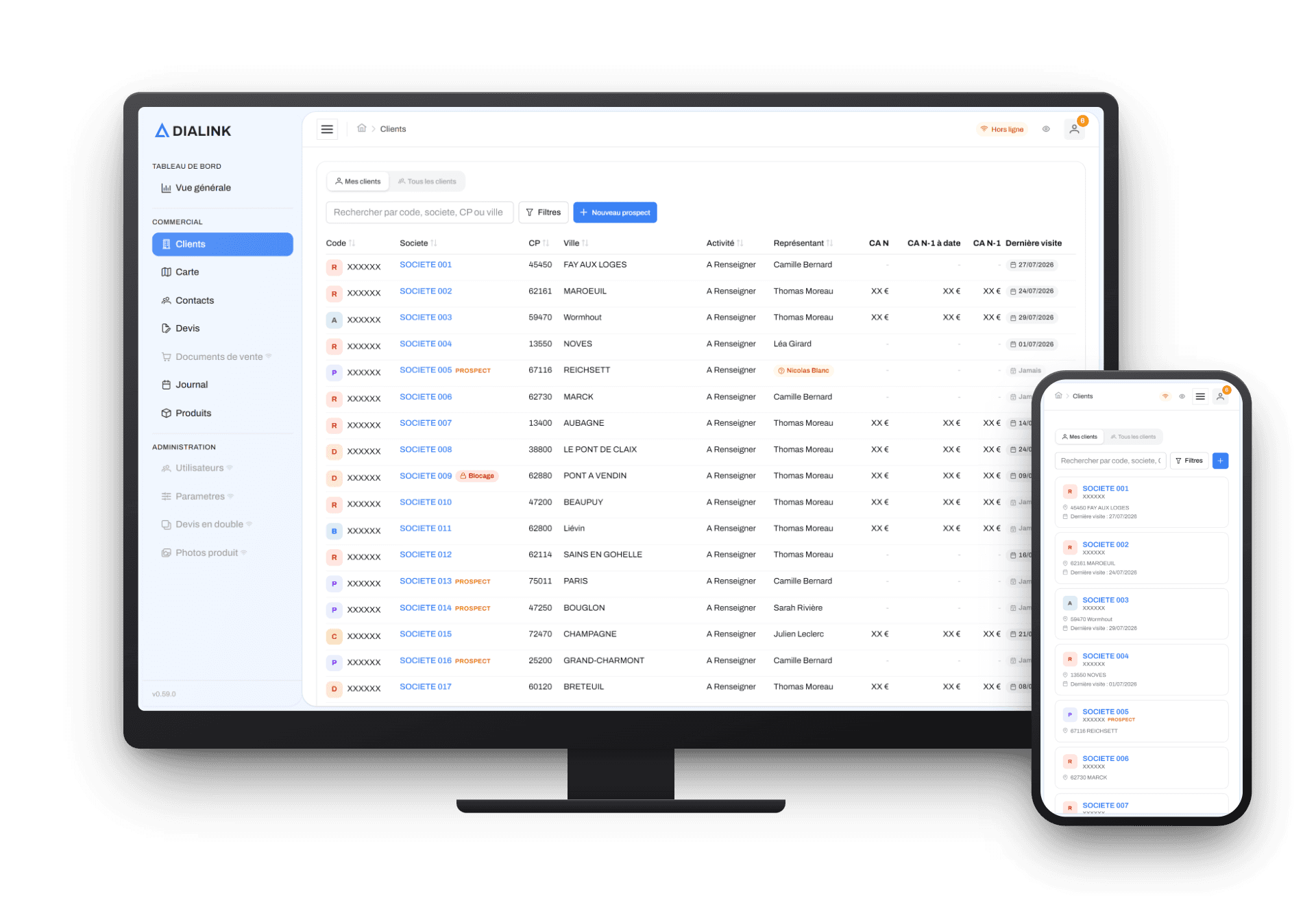
Customer portfolio, contacts, products and quotes stay available with no network. Features that require a connection are clearly flagged in the menu rather than failing on click — the rep always knows what they can do.
Dialann
Dialann's sales reps work on customer sites, often where mobile coverage falls short. DiaLink keeps their portfolio available offline and resynchronises as soon as the network returns.
A travelling sales rep spends the day where coverage is unreliable: industrial estates, basements, rural areas. Yet that is precisely when they need the history of the customer sitting in front of them — their revenue, their recent quotes, the date of the last visit.
A conventional CRM, querying the server on every screen, becomes unusable in those conditions. The logic had to be inverted: the data lives on the device, and synchronisation happens in the background whenever it can.
Customer portfolio, contacts, products and quotes stay available with no network. Features that require a connection are clearly flagged in the menu rather than failing on click — the rep always knows what they can do.
Each customer shows their code, account manager, revenue for the year, last year to date and for the full year, plus the date of the last visit. Enough to prepare a meeting at a glance.
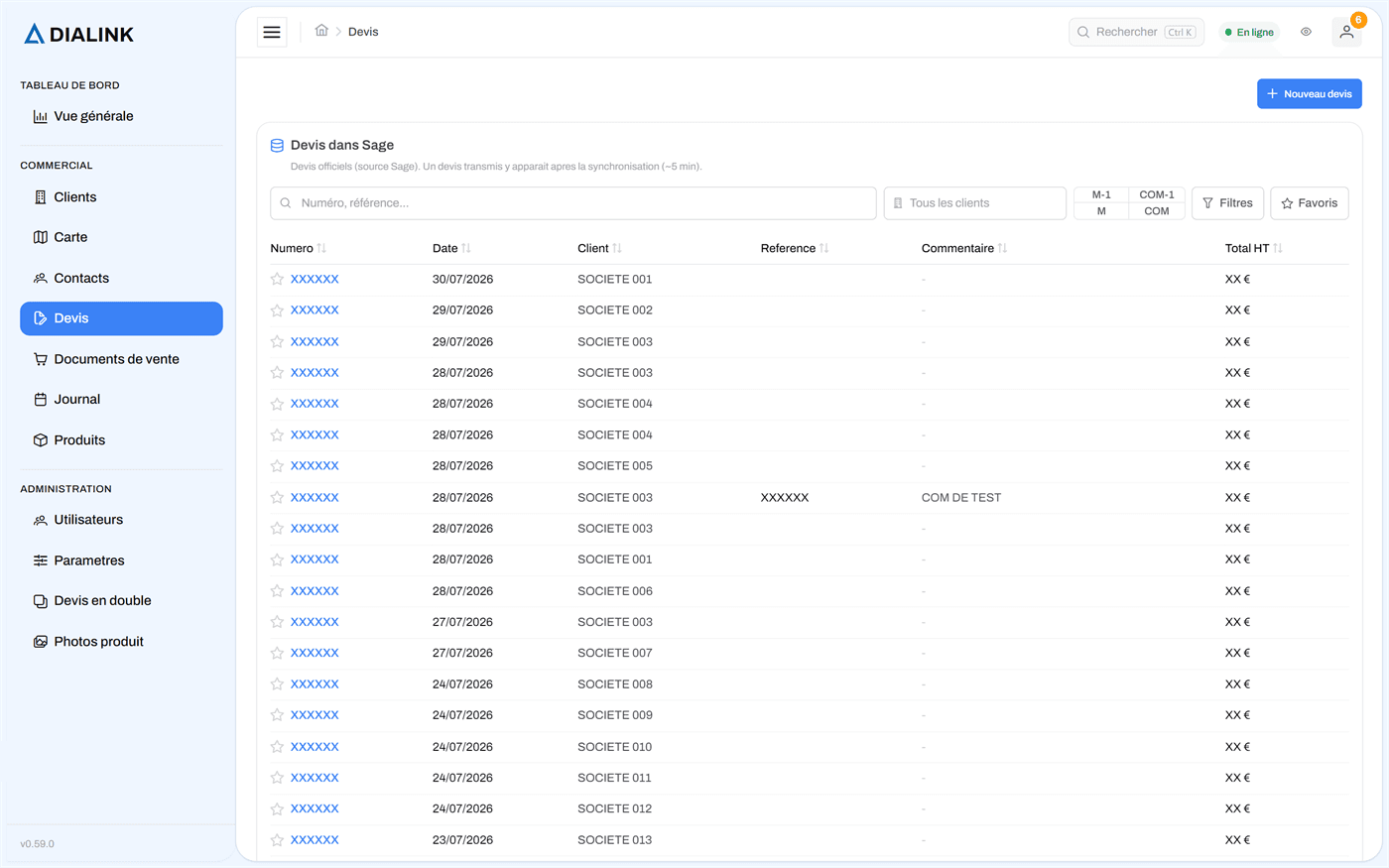
Quotes are prepared in the application then sent to Sage 100, where they become official documents. The interface states the synchronisation delay explicitly, removing any ambiguity about a quote's status.
A map view locates customers and prospects, so a round can be organised around where accounts actually are rather than from an alphabetical list.
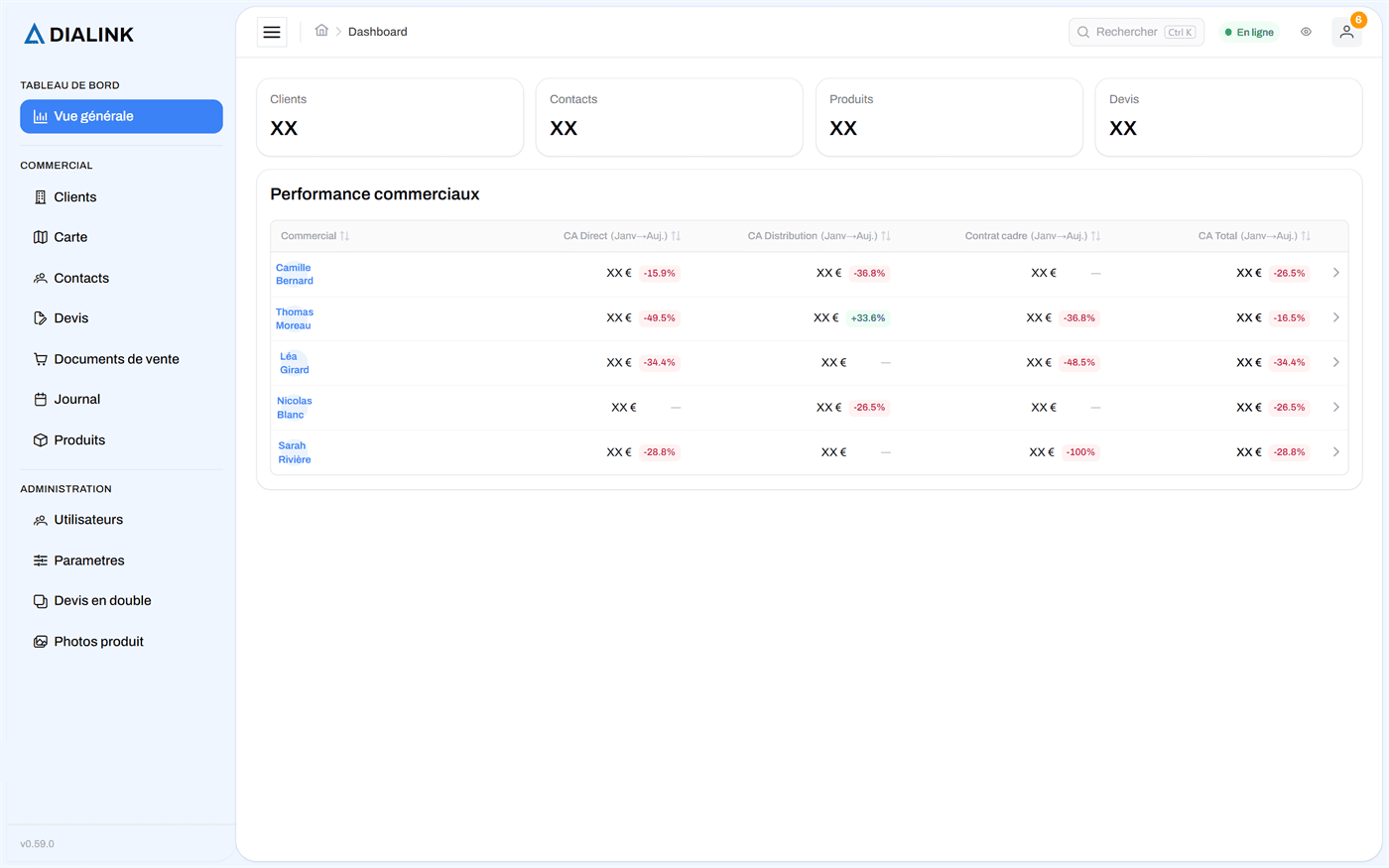
The dashboard tracks performance per rep — direct, distribution and framework-contract revenue — with year-on-year movement. An admin area handles users, settings and duplicate quotes.
DiaLink is a progressive web app: it installs on a phone or tablet straight from the browser, with no app store involved, and updates itself.
Offline mode isn't a cache layer bolted on afterwards: it's the operating principle. The application reads from and writes to a local database, and a synchronisation engine reconciles that data with the server.